Corporate clients still raised letters of credit through wet ink, couriers and opaque handoffs, with no way to see where anything stood. I owned the 2024 redesign of smartTRADE's letter-of-credit, guarantee, discrepancy, settlement and tracking journeys, Emirates NBD's online trade hub, while preserving UCP 600 and maker-checker controls.
platform context reported by Emirates NBD, public sources · redesign shipped 2024
Sr. Product Designer · smartTRADE, Emirates NBD
Cross-functional squad: product, trade ops, engineering, design
2024 · Emirates NBD, Dubai
Figma · usability testing
Owned smartTRADE's trade-finance journeys, and held one line: drop the paper, keep the controls. Led the research, journey design, document upload, approval flows, review-before-commit and the live tracking dashboard.
Redesigned the import-LC, discrepancy and settlement journeys on the platform carrying ~25% of the UAE's letters of credit: one tabbed canvas, a single review-before-commit, maker-checker governance fully intact.
Regulated trade instruments (UCP 600 / ICC rules), maker-checker governance, document-heavy workflows and many products inside one hub.
Emirates NBD put AED 1 billion into digitising its corporate bank. Trade finance was among the most paper-bound parts of that estate, and among the most valuable: the bank holds roughly a quarter of the UAE market in regular letters of credit.
Trade requests up 2.5× (2019→2021), guarantee processing 80% faster, fully paperless for government clients.
Journeys that had won on availability, redesigned to win on usability: the LC wizard, discrepancies, settlement.
Maker-checker and every regulated control stayed fully intact. Only the wet ink and couriers left.
Every LC, guarantee or trade-loan request meant a physical dossier, signed in wet ink and carried to a branch before anything could move.
Once a request was in, the client had no way to see where it stood. Status meant phoning the relationship manager or chasing trade ops.
The same terms were typed and re-typed across forms by hand. Manual handling bred redundancy, rejections and rework on tiny discrepancies.
LCs, guarantees, collections and loans each lived in their own process. A treasury team had no one place to run their trade portfolio.
Raising an import LC, the core task. Before and after smartTRADE.
The bet behind it. The fastest way to speed up the paper process is to thin the bank's maker-checker approvals. But in trade finance the controls are the product. So the rigor stayed, maker-checker, fully intact and digital, and the speed came from everywhere else: saved clause templates, digital upload, live status. Trust survived the move online; only the paper didn't.
Days of paperwork with no status, now LCs, guarantees, collections and loans run online, in one place, with status you can track.
Learn the real trade-ops anxieties, prototype a flow that keeps the bank's controls but loses the paper, and validate it sprint by sprint with engineering.
in their own words
“I just need to know my guarantee was received and is moving, not find out three days later it bounced.”
“Our LCs all share the same clauses. Typing them fresh every time is where the mistakes creep in.”
“Nothing leaves our company without a second pair of eyes. The tool has to respect that.”
A separate tool per product ships faster, but it rebuilds the old silos and makes users relearn the bank product by product. Instead: one hub, one pattern, the whole portfolio in one place.
A service blueprint of the journey showed the blocker wasn't the form. It was the missing visibility and second-eyes governance once paper left the building.
LC and guarantee flows with reusable clause templates, digital upload and a maker-checker route built in, not bolted on.
Usability-tested the online flow against the paper process. Far faster, with far more confidence a request was moving.
Delivered a responsive design system so the same trade patterns held across products and devices, and new instruments could be added without redrawing the hub.
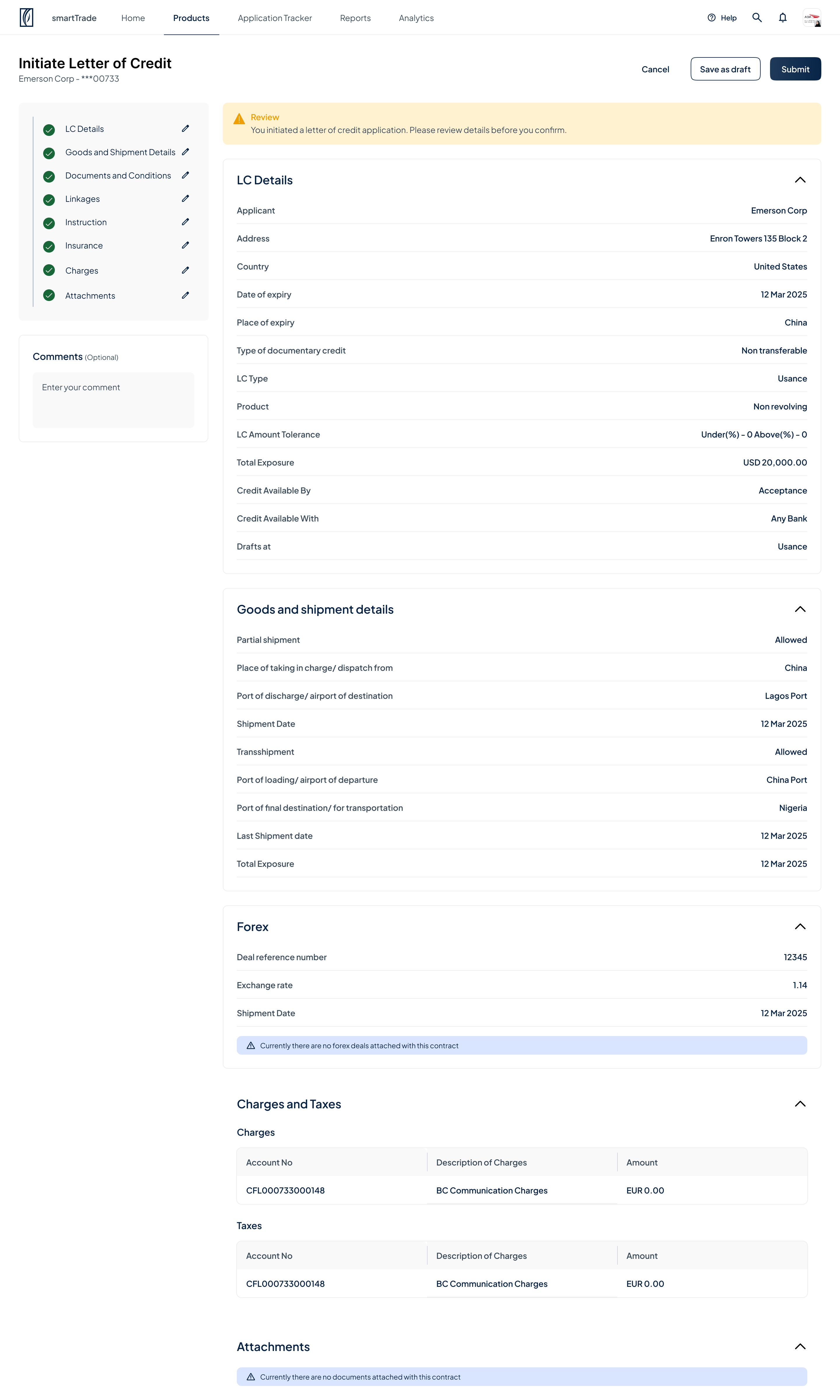
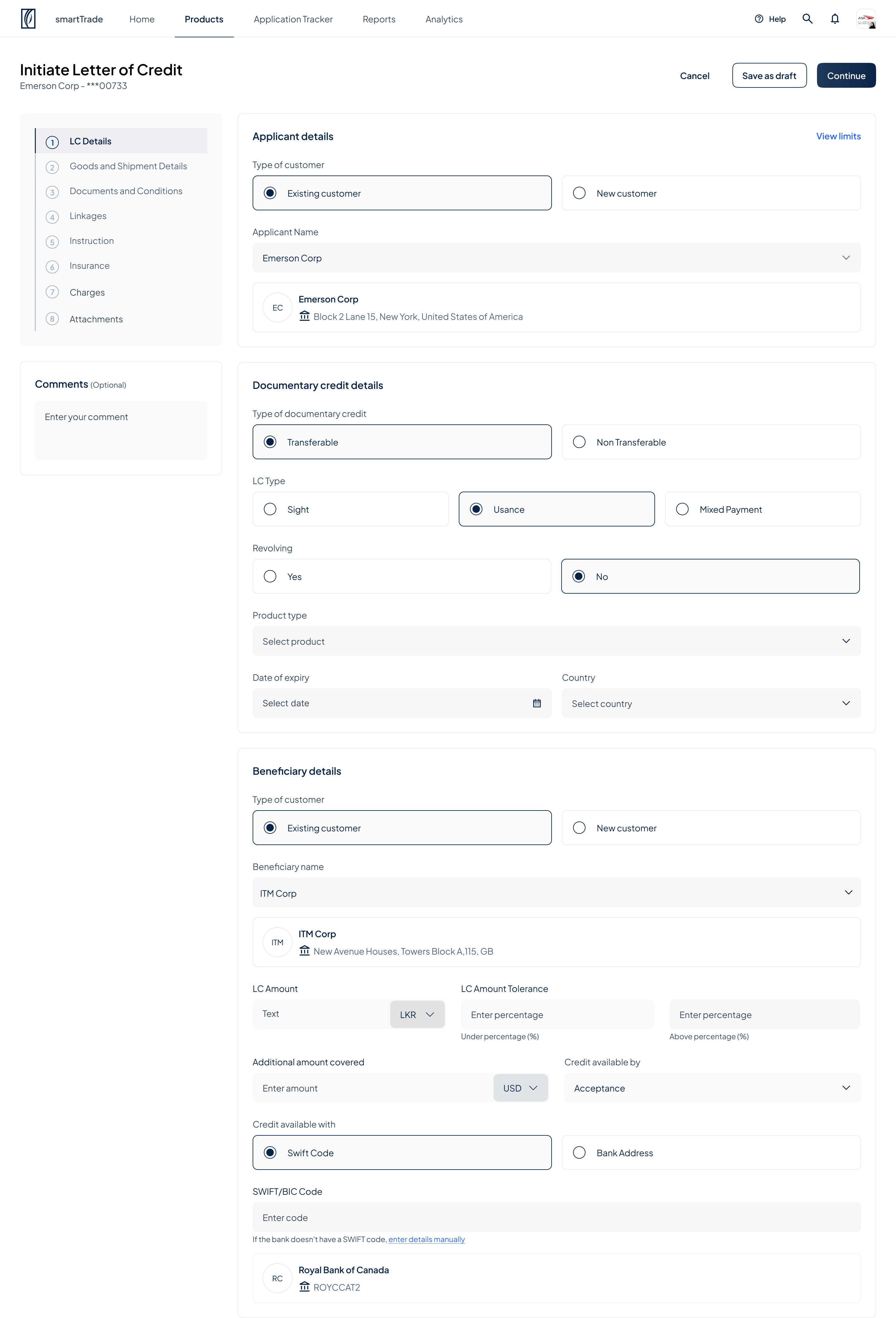
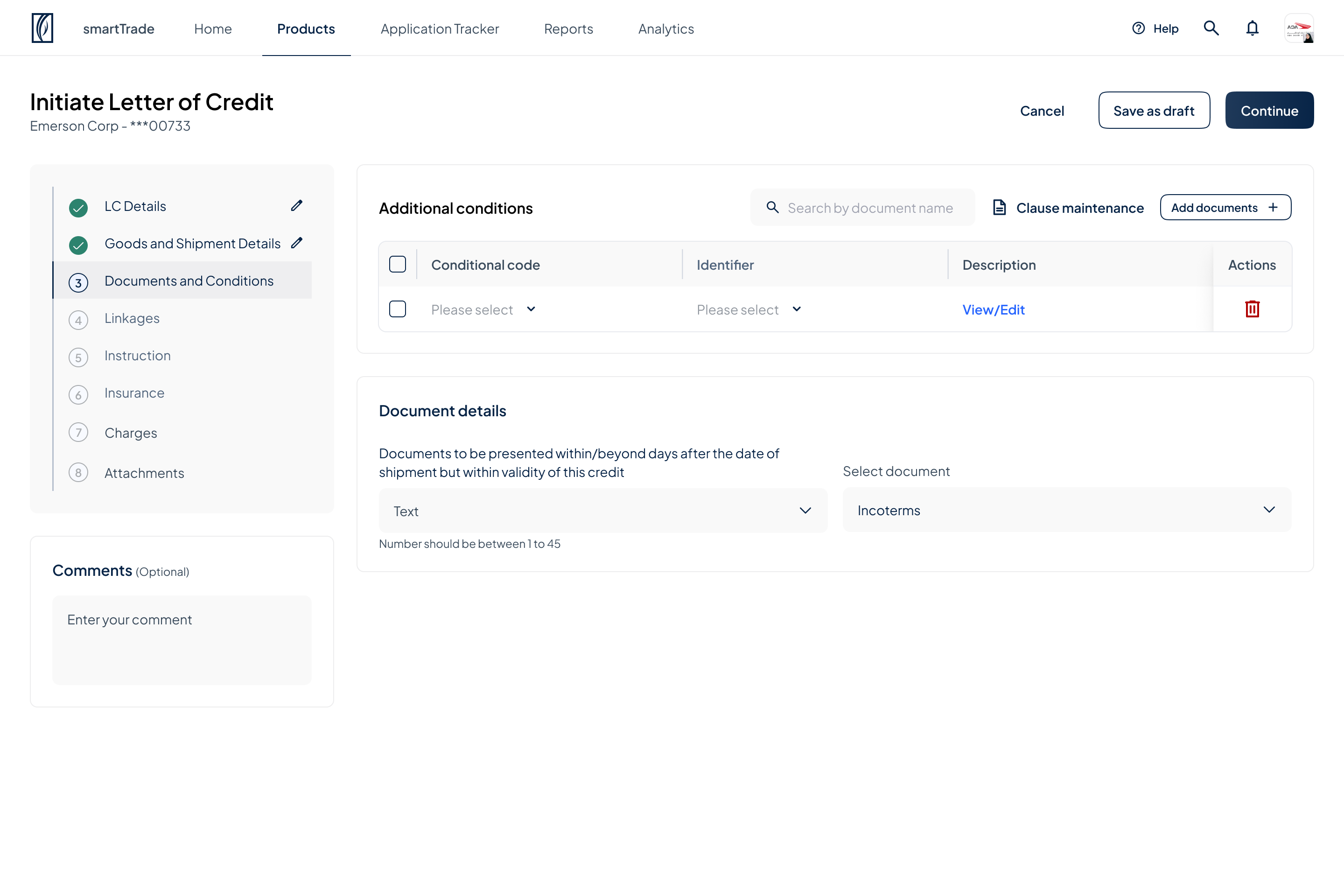
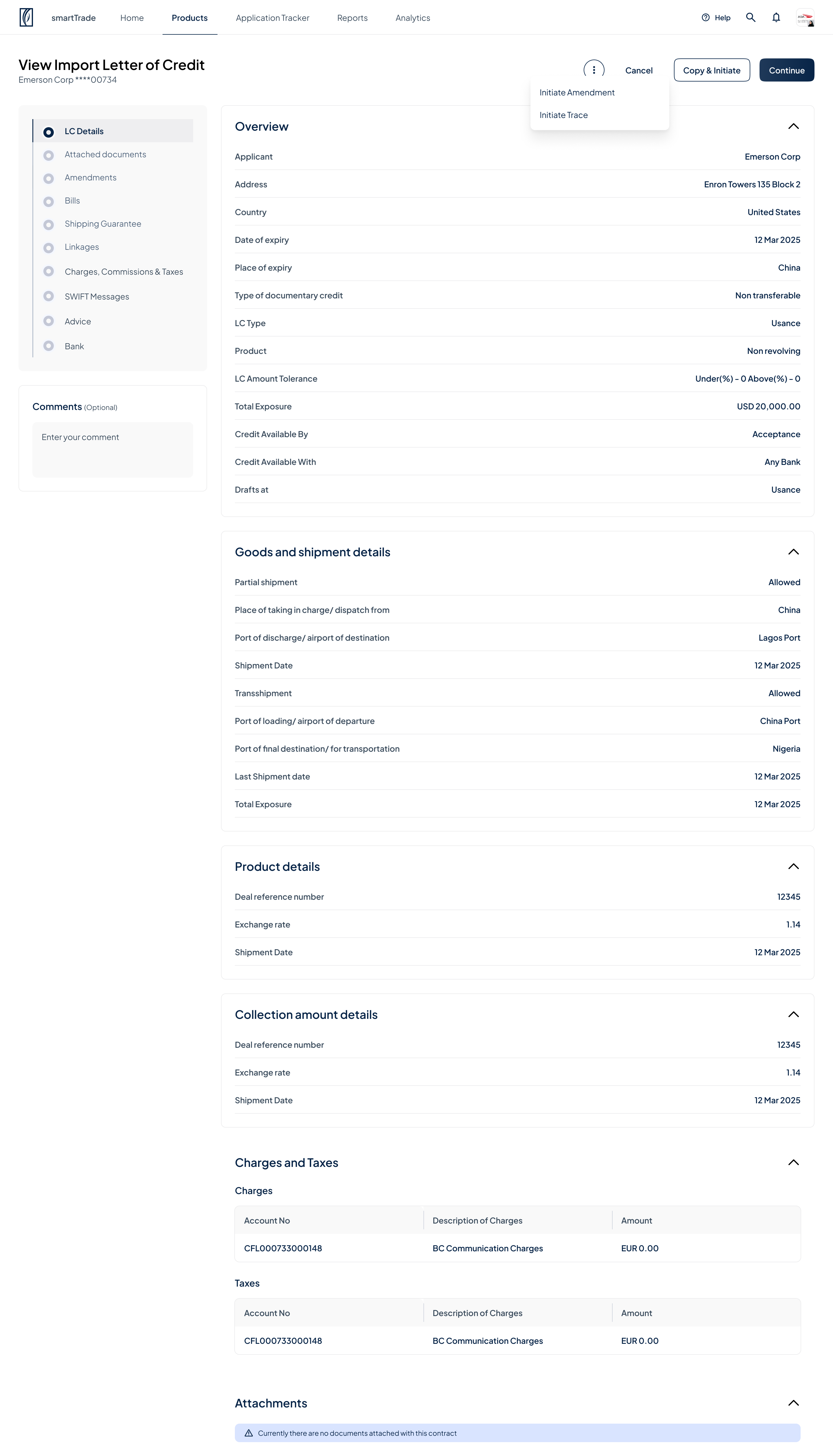
An import LC is one of the most field-heavy instruments in banking. I designed it as a nine-step tabbed canvas that ends in one scannable review before anything is committed.


The core journey, the way a user moves through it: fill the tabs in any order, attach what's needed, review before committing. scroll, the screen follows each step ↓
Applicant, beneficiary, amount and credit terms. The tabbed canvas lets users jump between sections instead of one endless form.
Select the documents the LC requires and add conditions, the terms once hand-typed onto paper, now structured and reusable.
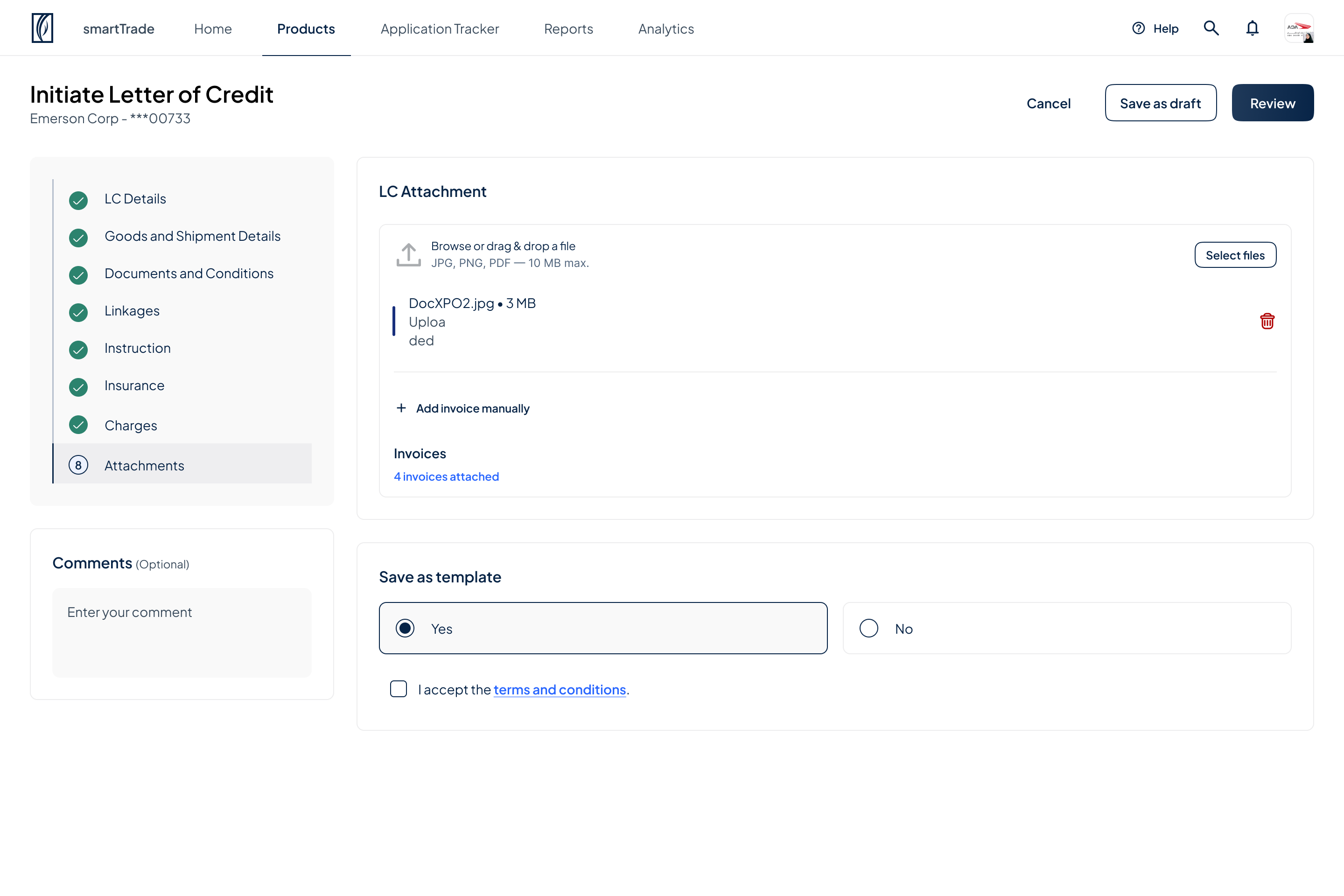
Invoices, proformas and supporting files upload right in the flow. The courier and the counter, replaced by drag-and-drop.
Every tab collapses into one scannable summary, with an inline error state if something's missing, before routing through maker-checker.
The hard part of digitising a regulated instrument is keeping its governance intact while shedding its paper. Four decisions carried that weight.
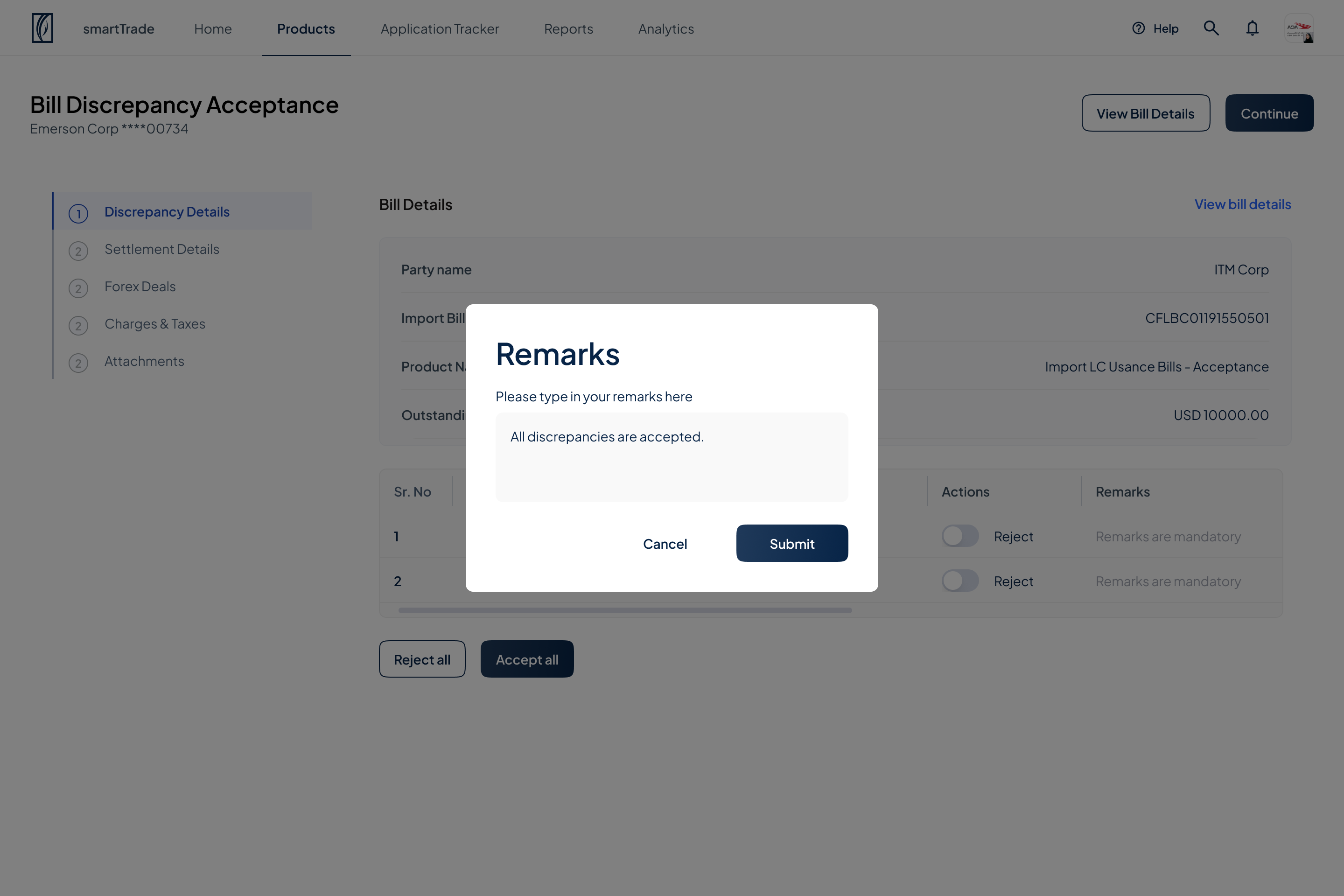
When a discrepant bill arrives, the user sees settlement, forex and charges together and accepts or rejects on one screen. The moment that once meant a phone call and days of limbo.
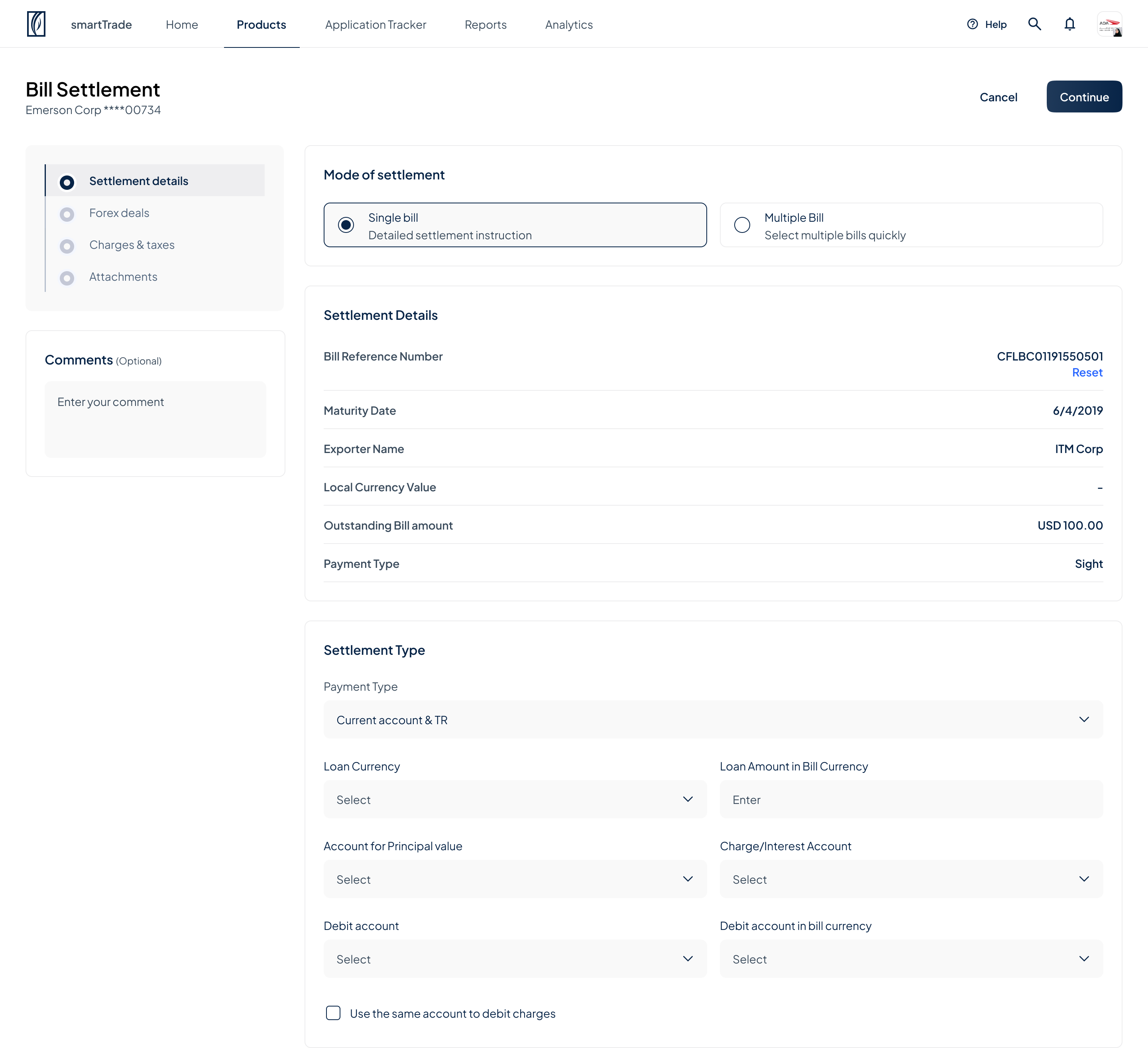
At settlement the user picks how to fund it (Trust Receipt, account debit, or account + loan) and links forex deals inside the flow. Financing is a choice, not a separate trip to the bank.
Create, amend, view and settle all share one tabbed anatomy. The Figma file's own note: "all the other tabs follow the same structure as LC creation." Learn it once, use it everywhere.
The Review step has expanded, collapsed and error states, so nothing submits half-finished, then routes through maker-checker for a real second pair of eyes.
the discrepancy screen, annotated · hover or tap the pins
The four flows that carry the module: initiate, view, accept a discrepancy, settle. click any screen to view it full size ⤢


The most field-heavy instrument in banking, raised from one tabbed canvas with a single scannable review before anything commits.
Discrepancy, settlement, forex, charges and attachments, decided on one screen instead of a phone call and days of limbo.
Create, amend, view and settle share one tabbed anatomy. Every new instrument added to the hub inherits it, with maker-checker intact.
redesign shipped 2024 · platform context (2.5× growth 2019→2021, 80% faster guarantees) reported by Emirates NBD, public sources
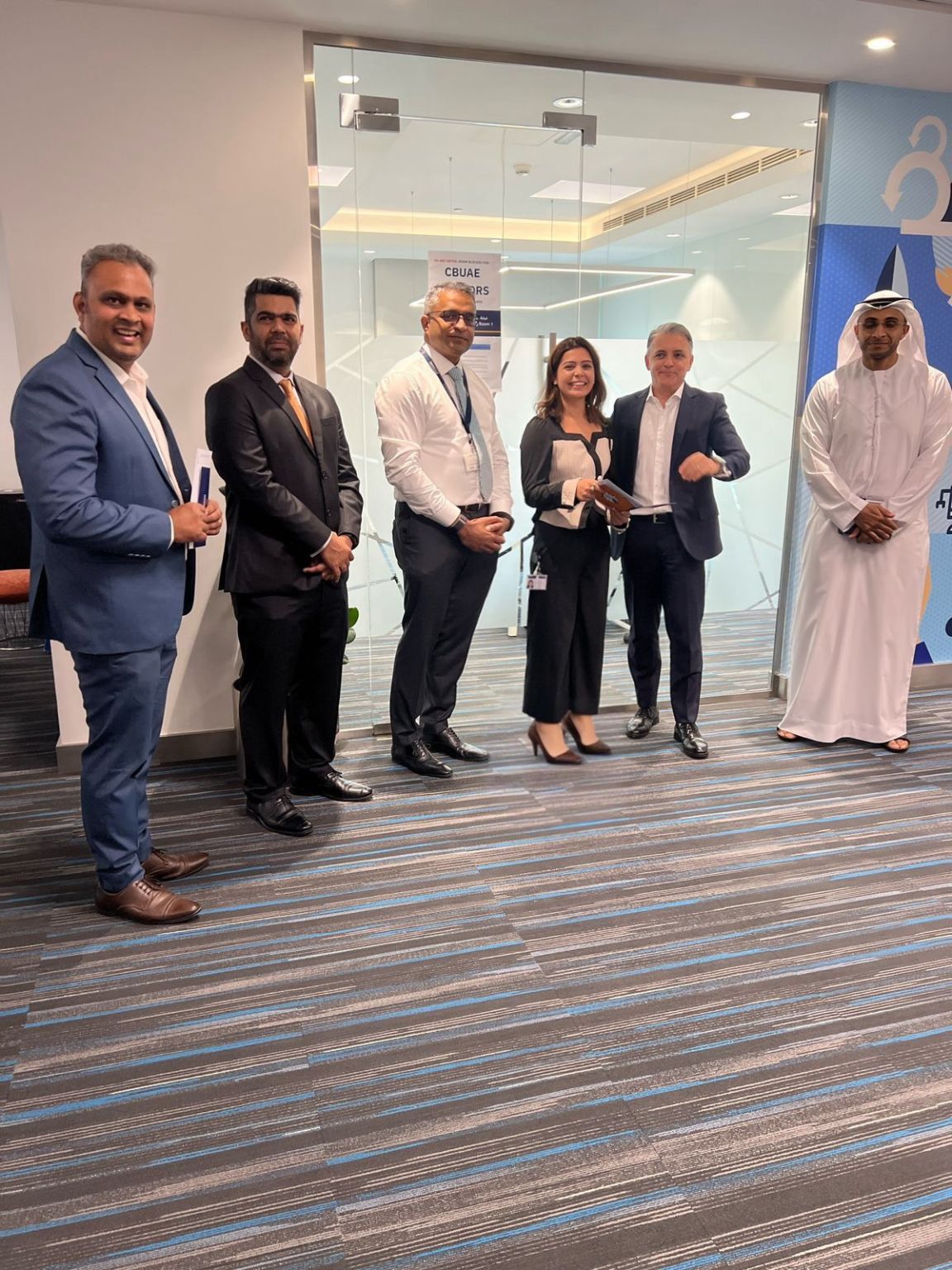
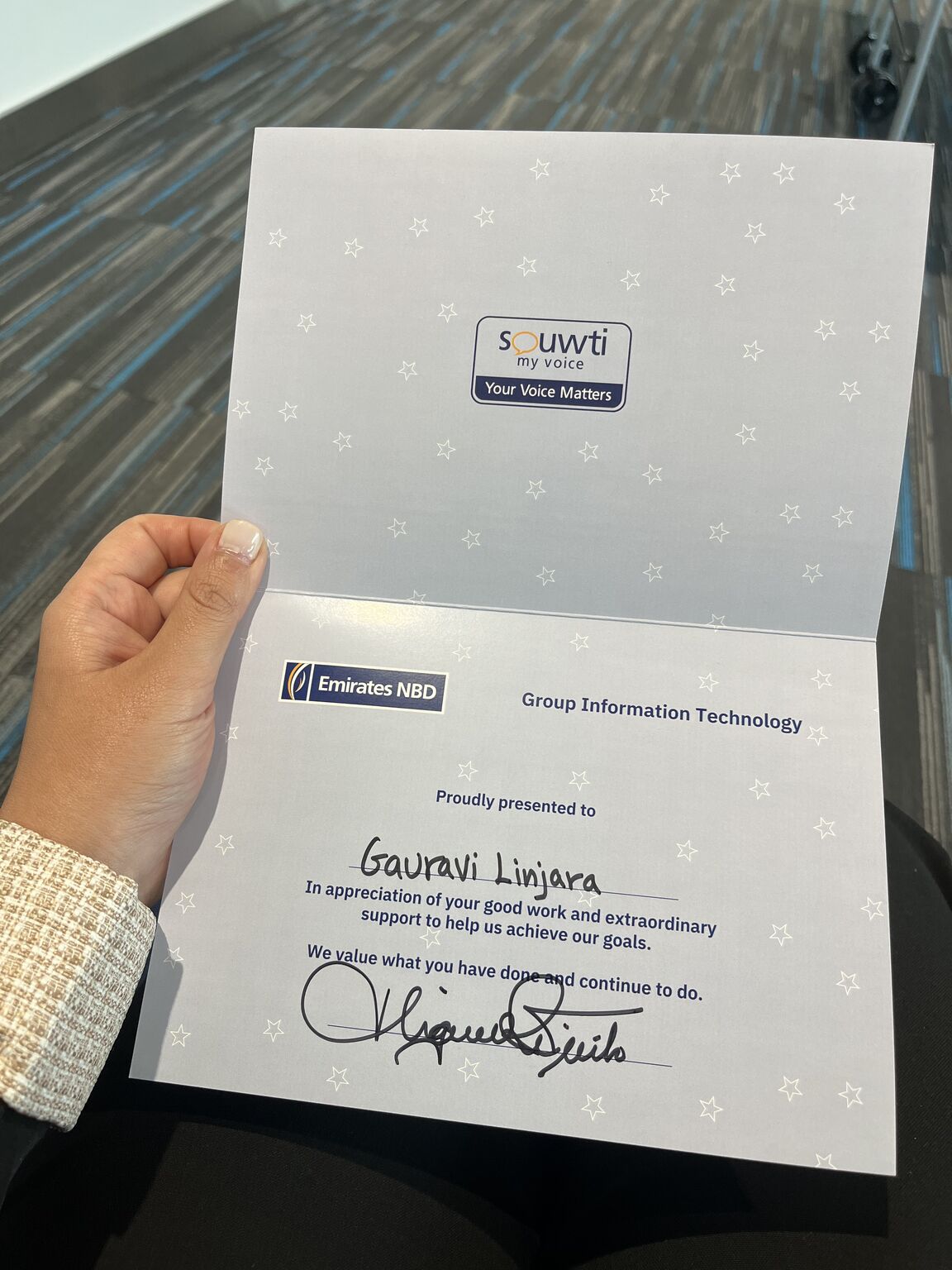
The bank's Group Information Technology team gave me a Souwti "Your Voice Matters" appreciation award for my work on the platform.
"In appreciation of your good work and extraordinary support to help us achieve our goals. We value what you have done and continue to do."
internal recognition · Emirates NBD Group Information Technology
This wasn't a tool per product. It was a re-alignment, one hub, one pattern, the whole trade portfolio in a single place instead of a stack of silos.
The controls were never obstacles to design around. They were product requirements that had to become understandable, predictable and difficult to misuse, so a corporate could raise and track a deal from their own desk.
Building it meant unlearning the old paper flow, blueprinting the journey, testing it sprint by sprint, and reworking until governance and convenience finally lived together.
And the pattern keeps growing. New instruments, predictive status, discrepancies caught before they happen, the hub should keep expanding long after this release.
A responsive design system and a reusable trade-request pattern, handed to engineering so the same governance held across every instrument in the hub.
Accessible by default: AA-contrast tokens, clear focus states, and legible numerals for amounts, references, and dates.